

Introduction
Cities around the world are setting ambitious urban canopy targets, an essential step toward climate resilience and healthier public space. Yet many municipalities struggle to turn those targets into reality. As identified in a recent cross-city urban forest study, the disconnect is rarely a lack of vision — it’s a breakdown in implementation. One of the most persistent barriers is tree setback rules, regulations that dictate where trees can’t go in relation to infrastructure like light poles, fire hydrants, and street furnishings and utilities.
Many of these setback standards are inherited, inconsistent between cities, or outdated relative to modern canopy goals. It’s time for municipalities to review these rules through the lens of real-world performance, design constraints, and cross-department coordination. Setback reform isn’t about choosing trees instead of infrastructure — it’s about planning for both, earlier and better.
Let’s examine why setbacks quietly remove trees from projects, how this impacts canopy outcomes, and what forward-looking cities are already doing to fix the gap between theory and practice.
Vision Versus Implementation
Cities are setting ambitious canopy targets to build cooler, climate-resilient streets. A 2024 study in Cities by Zhaohua Cheng (University of British Columbia), shows that the disconnect is less about goals and more about how goals meet operational reality.
As the paper explains: “While strategic policies often highlighted synergies, policy implementation processes and outcomes often encountered trade-offs,” and importantly, “trade-offs more often occur between operational processes or outcomes, rather than at the policy level.”
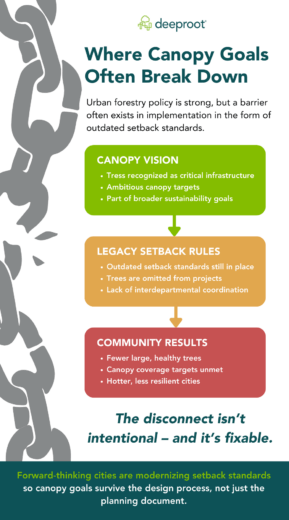
One of the most persistent operational barriers is tree setback rules — inconsistent, inherited standards dictating how close trees can be to infrastructure like hydrants, poles, curbs, and utilities. The study calls these setbacks “a major barrier,” noting “Infrastructure overall made tree planting and retention difficult because of various setback requirements and limited tree-friendly space.”
If cities want canopy targets to succeed, they must first evaluate whether their operational rules are aligned with their stated climate and forestry goals.
Consequences
When rules overshadow execution, the impact lands downstream. The study observes that “Trees, as deemed as a risk to infrastructure, were often removed or not planted,” and that “Trees may be prevented from being planted anywhere near infrastructure to avoid any potential risks or harms.”
Additionally, many setback requirements are not about safety but about the utility department’s desire to reduce future maintenance costs associated with working around trees. This manifests itself in two ways:
- Setback requirements that are excessive, beyond the needs of safety, so that utility crews won’t have to incur additional costs associated with working around or near trees
- Setback requirements that are only based on reducing “future potential maintenance access costs” and have no health and safety justification
This creates a pattern where:
- Designers remove trees early, anticipating rejection
- Utility reviewers red-line trees later, frequently without forestry input
- Soil volume is lost or fragmented in rights-of-way, never recovered elsewhere
What suffers most is not design ambition — it’s canopy outcomes, which fall short despite public mandates and climate commitments.
Solution
Cheng shows that the same areas generating conflict — redevelopment and infrastructure — also hold the greatest opportunity, suggesting “areas of opportunity to transform trade-offs into synergies through appropriate planning and monitoring.”
A better path is not removing setbacks entirely, but reforming them thoughtfully:
- Maintain safety-critical clearances (hydrants, intersections, emergency access)
- Audit legacy or inconsistent distances city-by-city and by infrastructure type
- Invite urban forestry teams into setback review earlier
- Replace defensive “no” defaults with collaborative “how can we make this work together?” frameworks. This new collaborative framework must be grounded in the Public Policy decisions made by municipal councils to achieve larger tree canopies, translated into implementation in the following ways:
- By reviewing utility setbacks for actual health and safety justifications and not historical precedence
- By making it clear to utilities that additional cost for working around trees is not a justification for increasing setbacks
- By the use of technologies like Root Barriers and Silva Cells that help to reduce setback requirements while preserving the function of both the tree and the utility
The study reinforces that resolving tree loss requires earlier integration into planning, better cross-department collaboration, and localized data to guide decisions. Setback reform supported by early cooperation gives cities a real chance to plant more trees, preserve continuous soil volume, and finally achieve canopy goals in practice.
Conclusion
Cities don’t fail canopy targets because they want fewer trees — they fail because their rules assume trees are secondary infrastructure, added late, or not at all.
A practical first step toward closing the gap between vision and reality is to review setbacks early, invite forestry into the process, and approve space for soil as essential infrastructure.
When cities plan for trees with the same seriousness as pipes and poles, they plant smarter, earlier, and together — and that’s how canopy targets become canopy reality.

Would be great to see the new setbacks recommended through this work. I would argue that a properly placed tree (on the opposite side from the hose connection) could be closer to a fire hydrant than other infrastructure which can be impacted by tree roots or has a more frequent access requirement.